Homestead, HOA/CDD Fees & Taxes: The Real Cost of Owning in Florida
Breaking down Homestead/Save Our Homes, how HOA & CDD fees work (vs. NYC common charges), and what to budget for new construction vs. resale
Buying in Florida is simpler than a NYC co-op—but the cost structure is different. Beyond principal and interest, your true monthly payment depends on Homestead/Save Our Homes, HOA (or condo) dues, potential CDD fees, insurance, and flood insurance. Here’s a clear guide to help you price a home like a local.
1) Florida Homestead & Save Our Homes (SOH): how your tax bill stays lower
Homestead Exemption (primary residence only)
Lowers your taxable value (up to $50,000 on most levies).
Unlocks the Save Our Homes cap once you’re homesteaded.
Save Our Homes (SOH) cap
Caps the annual increase in assessed value at 3% or CPI (whichever is lower).
Over time, your assessed value often trails market value—creating a cap differential that protects you from big tax jumps.
Portability (if you move within Florida)
You can transfer (port) up to $500,000 of that cap differential to your next Florida homestead (within three tax years), lowering the starting assessed value there.
Key dates
You must own and occupy by January 1 and file by March 1 to get Homestead for that year.
Translation: Claiming Homestead early protects your future taxes; failing to file can cost you thousands over time.
2) HOA & Condo Dues vs. NYC Common Charges: what’s the same—and what’s not
Similarities
Cover shared amenities (landscaping, pools, gyms), common-area utilities, management, insurance on shared elements (in condos), and reserves.
Key Florida differences
Condo (3+ stories): Florida now requires Structural Integrity Reserve Studies (SIRS) and prohibits waiving underfunded structural reserves—great for long-term safety, but dues may rise as buildings “catch up.”
Single-family HOAs: Dues vary widely by amenities (gate, clubhouse, pools). You’ll carry your own homeowners insurance (unlike a condo’s master policy).
Why this matters: Two similar-looking communities can have very different reserve health and future dues—always read budgets, reserves/SIRS, and minutes.
3) What’s a CDD—and why do I keep hearing about it?
Community Development District (CDD) fees fund roads, utilities, lakes, landscaping, and amenities in many newer master-planned communities.
Paid with your property tax bill (not part of HOA dues).
Typically two parts: bond (debt) + operations/maintenance.
Bonds amortize; O&M continues annually.
Rule of thumb: A home with lower sticker price in a new community may carry a meaningful CDD—which can make its true monthly similar to a higher-priced resale without CDD.
4) New Construction vs. Resale: budgeting differences
New Construction
Pros: New roof/electrical/plumbing (insurance may be friendlier), latest wind codes, warranty.
Cons: Often in CDD communities; taxes on first full year can jump once county re-assesses new construction; design upgrades add real dollars; “$0 HOA now” can rise when amenities open.
Resale
Pros: Established taxes (easier to estimate), mature landscaping, sometimes no CDD.
Cons: Roof age and wind mitigation can raise insurance; condos may face special assessments if reserves are thin or big projects are due.
5) The Florida “True Monthly” formula (copy this)
True Monthly =
P&I (mortgage)
Property Taxes (annual ÷ 12; adjust for Homestead/SOH once eligible)
Homeowners Insurance (wind/hurricane)
Flood Insurance (if required/advised)
HOA/Condo Dues
CDD (if applicable; it’s in your tax bill, but include it here so you see the whole picture)
Optional: add average utilities for a complete monthly.
6) Side-by-side example (illustrative)
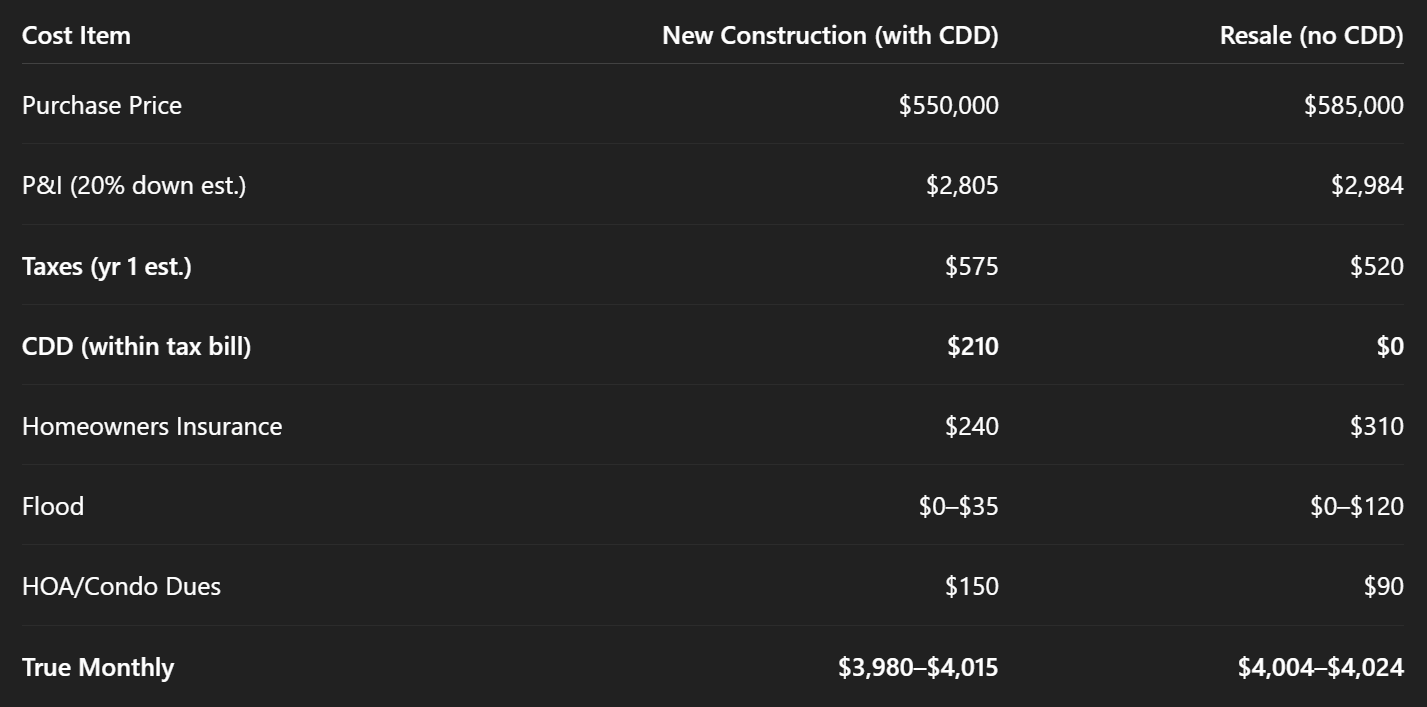
Takeaway: The “cheaper” home can cost the same—or more—monthly once you include CDD, insurance, and flood. Always run the math.
7) What to ask (before you offer)
Taxes & Homestead
Is the seller homesteaded (today’s taxes may be artificially low for you)?
What will the county’s assessed value likely be after sale/completion?
Timeline to file Homestead (and portability, if applicable)?
HOA/Condo
Current budget, reserves/SIRS, insurance deductibles, and special assessments (current or pending).
Leasing rules, pet rules, and use restrictions (if you plan to rent part-time).
CDD
Bond maturity schedule and annual O&M.
Planned amenity expansions that could change O&M.
Insurance
Roof age/shape, wind-mit credits, prior claims; flood zone + Elevation Certificate if AE/VE.
8) Common mistakes (and easy fixes)
Using the seller’s tax bill as your projected taxes → Ask your agent to model post-sale taxes and CDD, then apply Homestead timing.
Ignoring CDD because “it’s in the tax bill” → Break it out so you see the full picture.
Skipping reserves/SIRS in condos → Underfunded reserves today often become special assessments tomorrow.
Forgetting flood in an X zone → Optional policies are inexpensive and can save your budget in extreme events.
9) Quick buyer checklist
☐ Post-sale tax estimate (with/without Homestead)
☐ CDD disclosure (bond + O&M) and payoff options
☐ HOA/Condo budget, reserves/SIRS, minutes, insurance summary
☐ Insurance quotes (home + flood) with wind-mit data
☐ Roof age/shape; elevation if applicable
☐ Compute True Monthly using the formula above
Bottom line
In Florida, the best deal isn’t just price per square foot—it’s risk-adjusted monthly cost over time. Homestead/SOH can protect your taxes, HOA/condo health determines future dues, and CDDs can equalize “cheap vs. pricey” homes once you do the math. Model it upfront and you’ll buy with confidence.
Want me to run a True Monthly on your short list (taxes with/without Homestead, CDD schedule, HOA/condo reserves/SIRS, and insurance quotes)? I’ll package it so your first offer is your best one.
Fernanda Stucken — Tampa Bay Realtor
📧 contact@fernandastucken.com | 📞 (347) 216-6620
This article is educational, not legal/tax advice. Confirm specifics with your county property appraiser, association manager, and insurance professional.